

caTEGORIES
Tags
Best Techniques to Secure Threaded Inserts for Metal and Concrete
Posted: February 19, 2026
Categories: News
Selecting the correct method to join parts is not merely about choosing a screw and wishing for success. You might be handling a demanding engine element or a solid concrete base, but the unseen fasteners—threaded inserts—perform the essential tasks. At Qewit, we have invested more than twenty years in learning how to keep these links firm and reliable.
Why Choose Qewit for Industrial Fastening Solutions?
As you search for hardware, you prefer a provider who comprehends your requirements and views “quality control” as a genuine essential, rather than mere jargon. Qewit functions as a British-owned enterprise situated in Qingdao, and this position offers us a distinctive benefit. We merge Western administrative approaches with the production strength from East Asia, which means you obtain the dependability you anticipate at prices that avoid excessive costs.
A Reliable British Owned Global Supplier
We began operations in 2004, and since then, we have emphasized acting as a knowledgeable intermediary. Our background as British-owned ensures that our leaders possess thorough insight into supply chain handling, so they confirm that goods from mainland China, Taiwan, and Vietnam conform to worldwide standards. Consequently, this delivers to our clients in Europe and the UK a seamless experience, extending from production areas directly to their storage units.
Strategic Supply Chain and Professional Support
Rather than simply dispatching containers, we oversee customer accounts with care. When a complex task arises, our group applies considerable effort toward technical elements to develop a customized answer. We manage a broad spectrum, including “Industrial Consumable Products” along with precise “Account Management,” and in doing so, we make sure the components you receive precisely suit the demands of your project.
Rigorous Quality Assurance and Certification
Quality stands as the foundation of our efforts. Both Qewit and our collaborating factories maintain ISO 9001 certification. Should your initiative require documents such as 3.1 certifications, Initial Sample Inspection Reports (ISIR), or PPAP up to level 3, we supply them without delay. Furthermore, we operate our own examination centers to assess tensile strength and hardness before any items depart from our premises.
How do Self-Tapping Inserts Enhance Metal Assembly?
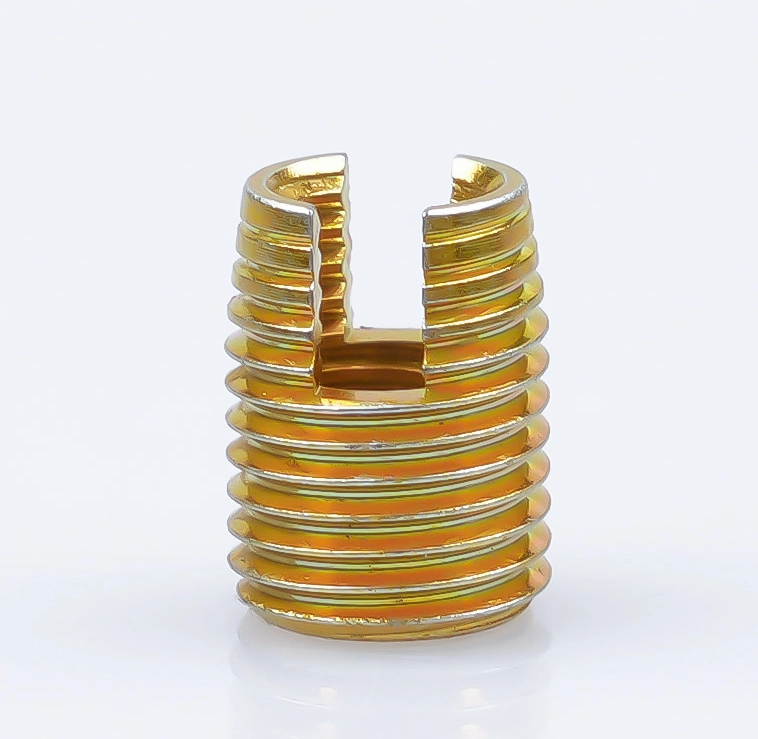
Within metal fabrication settings, you commonly encounter substances such as aluminum or brass that lack sufficient firmness to retain threads independently over extended periods. When you attempt repeated direct insertion of screws into these materials, the threads wear away in time. Self-tapping inserts resolve this problem effectively, as they form a durable, abrasion-resistant internal thread that withstands far greater strain compared to the underlying material.
High-Hardness Hardened Steel Construction
Our hardened steel inserts are constructed for durability. They function as a protective barrier for the internal threads, delivering a robust connection in substances that otherwise exhibit weak shear capacity. Therefore, by incorporating these inserts, you can opt for less dense materials in your core framework, yet still benefit from the secure bolt retention associated with sturdy steel.
Superior Vibration and Loosening Resistance
Vibration represents a significant issue in mechanical systems. As components begin to vibrate, fasteners often loosen progressively. These inserts are engineered to install securely, in a manner similar to how a nylon insert nut depends on frictional force to remain in place. Moreover, the external threads on the insert embed into the metal, which establishes a bond that holds steady even amid operational noise and motion.
Versatile Surface Finishes for Corrosion Protection
Untreated steel endures briefly in practical applications, so we provide several coating alternatives. You may select traditional Zinc Plated options, or for environments like outdoors or mining operations, we offer Zinc Flake or Geomet treatments. These applications assist the parts in enduring exposure to salt and humidity, preventing corrosion and subsequent binding.
What are the Best Practices for Wood Threaded Inserts?
Wood presents a distinct challenge when contrasted with metal, given its fibrous structure, tendency to swell, and susceptibility to splitting under improper handling. For tasks involving furniture or cabinet construction, you require an insert that enters smoothly but remains fixed permanently. The effectiveness hinges on the drive type and the thread configuration.
Hexagon Drive for High Torque Stability
When dealing with dense hardwoods or requiring substantial depth, the Hexagon Drive (Hex Socket) proves ideal. It enables the use of a hex key or powered instrument to insert the component with ample rotational force. Since the tool engages deeply within the head, the risk of slippage or damage to the drive recess during the process diminishes substantially.
Slot Drive for Simple Manual Installation
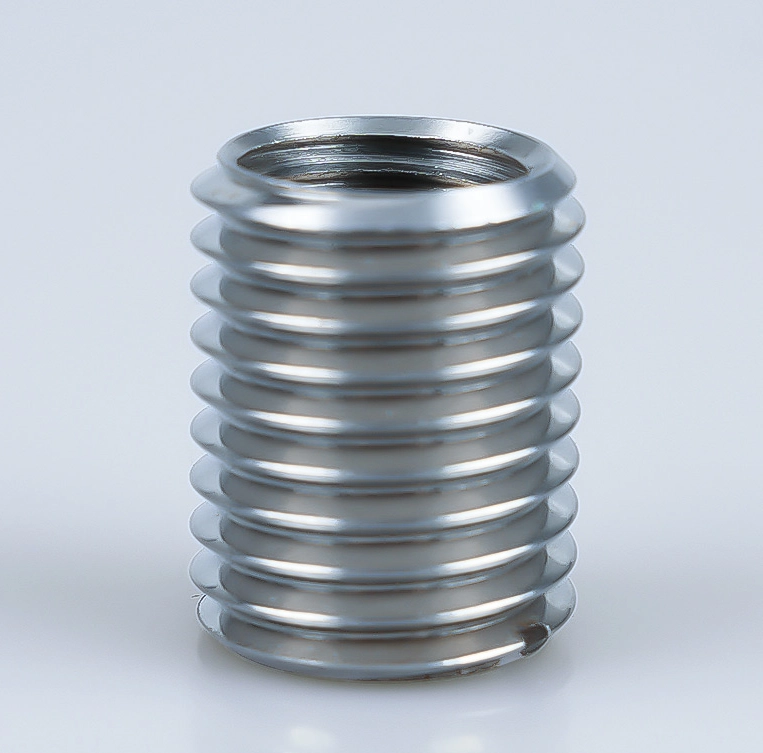
In cases where advanced equipment is unavailable, a straightforward Slot Drive performs adequately. This established style allows installation via a basic flat-head screwdriver. As a result, it serves as an economical option for flat-pack furniture, particularly where individuals assemble the pieces on their own.
Optimized Thread Design to Prevent Cracking
The essential feature for wood inserts resides in the threading. We employ coarse threads featuring a broad pitch—reminiscent of wood screws—to penetrate the fibers without excessive compression. Additionally, many of our configurations include a notched or channeled tip, which facilitates the removal of debris during insertion and thereby reduces the likelihood of the wood fracturing lengthwise.
Why are Concrete Screws Considered Superior for Heavy Fixings?
Individuals typically envision large expansion bolts or cumbersome chemical anchors when considering attachments to concrete. However, concrete screws, occasionally termed concrete self-tapping anchors, have transformed the approach. They facilitate quicker installation, produce minimal debris, and in numerous instances, achieve equivalent strength levels.
Direct Installation Without Auxiliary Accessories
The primary advantage of concrete screws lies in their self-contained process. No supplementary elements, such as plastic sleeves, metal wedges, or chemical resins, are necessary. You simply create a hole and insert the screw directly. Furthermore, the threads receive specialized hardening to engage the concrete and establish their own secure pathway.
Detachable and Reusable Post-Anchoring Design
Traditional expansion anchors generally become permanent once placed, often necessitating cutting tools for removal. Concrete screws differ in this regard, as they permit unscrewing for extraction. This characteristic renders them suitable for provisional structures like barriers, formwork, or assignments that may involve later adjustments.
Advanced Heat Treatment to Prevent Hydrogen Embrittlement
Producing a screw with adequate hardness to penetrate concrete, while maintaining flexibility to avoid breakage, requires precise equilibrium. Excessive hardness in the steel can lead to brittleness and abrupt failure, a condition called hydrogen embrittlement. We implement targeted heat treatment methods and comply with European norms to ensure our alloy steel screws deliver strength without the danger of fracturing under load.
How to Optimize Fastener Performance and Longevity?
Achieving proper installation of a part constitutes just one aspect of the task. Ensuring its endurance over multiple years is equally crucial. This typically involves selecting suitable additional hardware and identifying the appropriate moments for replacements.
Strategic Selection of Locking Nut Varieties
When your setup includes bolts and nuts, refrain from depending on ordinary nuts in expectation of reliability. We provide five key varieties of lock nuts. In areas prone to high vibration, a Nylon Insert Lock Nut excels, as the nylon element secures the threads firmly. In contrast, for regions with elevated temperatures where nylon could degrade, an All-Metal Lock Nut or a 30° wedge (Spirax) nut offers greater safety.
Professional Sorting and Packaging Services
We understand that even one defective screw can halt an entire automated production sequence. For this reason, we extend Roller Sorting and Optical Sorting services to detect any irregularities prior to delivery. We also tailor packaging to your specifications, whether in large bulk bags for industrial use or compact boxed sets for commercial distribution.
Regular Maintenance and Replacement Protocols
No component endures indefinitely, particularly in demanding conditions. Items such as nylon cable ties in external settings warrant replacement every one to two years, since solar exposure and atmospheric elements gradually weaken the plastic. Maintaining consistent oversight of your fasteners—especially in intense applications like bridge assembly or heavy equipment—provides the optimal strategy to avert potential quality issues in the future.
FAQ
Q1: Can I reuse concrete screws once I’ve taken them out?
A: Yes, reuse is feasible, yet caution remains essential. Each insertion into concrete results in gradual thread erosion. If the threads appear worn or the screw fails to engage securely upon reinsertion, it is advisable to discard it and employ a replacement.
Q2: What’s the difference between a “Self-Tapping” and a “Self-Drilling” screw?
A: This distinction often confuses users. A self-tapping screw generates its own threads but typically demands a preliminary pilot hole. Conversely, a self-drilling screw incorporates a drill-bit-like tip that forms both the hole and the threads simultaneously, thereby reducing time significantly in metal-to-metal applications.
Q3: Does the color of a Zinc finish actually matter?
A: Indeed, it carries significance. Although Bright Zinc (silver) prevails as the standard and presents an attractive finish, Yellow Zinc generally affords improved resistance against rust. For options that combine visual appeal with fundamental corrosion defense, Black Zinc emerges as a favored selection in automotive or ornamental contexts.


