

caTEGORIES
Tags
Avoid Wood Splitting: 5 Tips for Installing Threaded Inserts in Softwood and MDF
Posted: January 15, 2026
Categories: News
Finding the right way to put a metal thread into a soft piece of timber or a sheet of MDF can be a bit of a headache. If the fit is too tight, the wood splits right down the grain; if it’s too loose, the whole thing just pulls out the first time someone sits on the furniture. For those working with lighter materials like pine or composite boards, getting that “perfect bite” is what separates a professional job from a DIY disaster.
Why Is Wood Integrity Critical During Fastener Installation?
When a fastener goes into a piece of wood, it isn’t just sitting there—it’s actively pushing the wood fibers apart to make room for itself. In hardwoods, the fibers are dense enough to resist this pressure, but in softwoods or MDF, the material is much more unforgiving.
Risk of Material Cracking in Brittle Fibers
Most softwoods have a very linear grain, which acts like a perforated line on a piece of paper. When a standard screw or a poorly designed insert is driven in, it creates “hoop stress” that wants to pop the wood open. If the fibers are brittle or particularly dry, you’ll see a crack start at the hole and run several inches deep, essentially ruining the workpiece.
Impact of Stress Distribution on Connection Strength
A good connection isn’t about how hard you can crank the bolt; it’s about how much surface area the fastener has to grab onto. In MDF, which is basically glued-up sawdust, there isn’t a grain to “bite” into, so the insert needs to distribute the load across as many layers of the board as possible to keep from stripping out.
Structural Benefits of Using Dedicated Wood Inserts
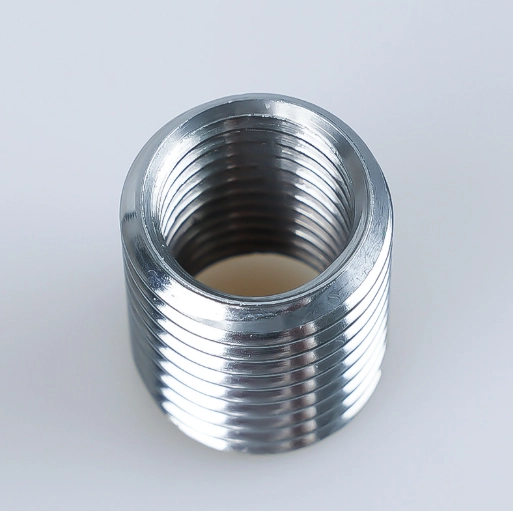
Standard machine screws won’t work in timber because they lack the “ribs” needed to lock into the base material. Dedicated threaded inserts act as a middleman, providing a wide external thread that grips the soft wood while offering a clean internal machine thread for bolts. This setup lets you take things apart and put them back together without wearing out the wood hole.
It really comes down to how the insert interacts with those fibers. This is where the specific design of the self-tapping edge makes a massive difference in whether the installation is a success or a mess.
How Does Self-Tapping Design Prevent Softwood Damage?
The goal of a self-tapping insert is to “cut” its way into the hole rather than just “wedging” itself in. This cutting action is what keeps the internal pressure low enough to prevent the wood from splitting.
Internal Thread Cutting Efficiency of Slot Drive Inserts
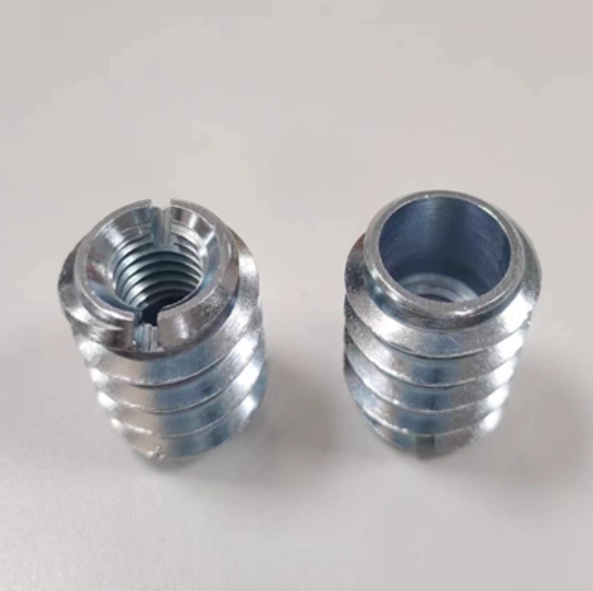
Qewit’s Self Tapping Inserts for Wood – Slot Drive are built with a specific cutting geometry. The slot at the bottom isn’t just for a screwdriver; it actually acts as a cutting edge that shears through the wood fibers as it turns. This “tail-cutting” design clears a path for the rest of the threads, which means the wood doesn’t have to stretch as much to accommodate the metal.
Advantages of Wide Thread Spacing for Fiber Grip
If the threads are too close together, they just turn the wood into mush. That’s why these inserts use a “coarse” thread profile with plenty of space between the peaks. This allows the wood fibers to remain intact between the threads, creating a much stronger “interlock” that’s hard to pull out.
Coarse Thread Performance in Medium Density Fiberboard
MDF is notoriously prone to “mushrooming” at the surface when you drive something into it. Using a coarse-thread insert helps bypass this because the large pitch moves the fastener into the material faster with less friction. It basically acts like a drill bit and a screw at the same time, which is exactly what a crumbly material like MDF needs.
Of course, the design of the thread only works if you can drive the insert in straight. Depending on the tools at hand and the space available, the drive type you choose—slot or hex—can change the whole experience.
Which Drive Type Offers Better Stability for DIY Projects?
For a lot of people, the hardest part is keeping the insert perfectly vertical. If it goes in at an angle, the bolt won’t line up later, and you’ll end up cross-threading the whole thing.
Precision Control with Hexagon Drive Systems
The Hexagon Drive Inserts from Qewit are a favorite for a reason. Because the hex wrench (Allen key) sits deep inside the insert, it’s much harder for the tool to slip out or “cam out”. This gives the user a lot more “feel” for how the threads are biting, which is great when you’re worried about over-torquing a soft piece of pine.
Traditional Versatility of Slotted Drive Components
Slot drive inserts are the old-school choice and they’re great because everyone has a flat-head screwdriver. They’re handy for quick repairs or when you’re working in a tight spot where a bulky hex tool won’t fit. Just keep in mind they require a bit more a steady hand to keep from slipping.
Torque Management to Avoid Over-Tightening Issues
One of the biggest mistakes is thinking “tighter is better.” In softwood, once the insert is flush, stop. Pushing it further will just strip out the very fibers you’re trying to grip. A hex drive makes it easier to judge this limit because you can feel the resistance build up more accurately than with a screwdriver.
While the drive type helps with the “how,” the material of the insert itself answers the “where.” If the project is going to be near a window or outdoors, basic carbon steel might not cut it for the long haul.
When Should Stainless Steel Inserts Be Your Primary Choice?
Standard inserts are usually zinc-plated, which is fine for a dry living room. But wood is a natural material that holds onto moisture, and that moisture can eventually eat away at cheap metal.
Superior Corrosion Resistance for Humid Environments
If you’re building something for a kitchen, bathroom, or a porch, Stainless Steel Self Tapping Inserts are a must. Unlike carbon steel, which relies on a thin outer coating, stainless steel is corrosion-resistant all the way through. It won’t rust if the wood gets a bit damp from humidity.
Material Durability in Long-Term Outdoor Applications
Outdoor furniture takes a beating from rain and temperature swings. Stainless steel handles these cycles without the metal becoming brittle or the threads seizing up. It’s a bit more of an investment upfront, but it beats having to drill out a rusted-in bolt two years down the road.
Aesthetic Maintenance and Surface Finish Integrity
Sometimes it just comes down to looks. Stainless steel has that clean, metallic finish that doesn’t flake or discolor over time. If your hardware is visible, like on a high-end designer table, the “original metallic color” of stainless is usually the preferred choice for a premium feel.
Reliable hardware is only one side of the coin, though. Sometimes a project is so specific that off-the-shelf parts just don’t fit the bill, and that’s where having a partner with deep technical roots comes in handy.
Can Qewit Support Bespoke Fastening Requirements?
Qewit isn’t just a warehouse; it’s a formally British-owned business that’s been around since 2004, bridging the gap between Western quality standards and Far Eastern manufacturing value.
Manufacturing Solutions Based on Customer Drawings
If a project needs a weird thread pitch or a specific flange size that isn’t in the catalog, the team can manufacture bespoke parts based on customer drawings or samples. They handle everything from forging to final machining to make sure the “customized special product” is exactly what the client needs.
Professional Quality Control and ISIR Certification
Quality isn’t left to chance. Every batch goes through a serious testing battery—salt spray tests, hardness testers, and even vision measurement projectors. They can provide full 3.1 certifications, Initial Sample Inspection Reports (ISIR), and PPAP level 3 for those who need to prove their supply chain is solid.
Extensive Product Range Covering 30,000 Global Lines
With over 30,000 product lines, most customers find they can get everything from hex bolts and nylon nuts to specialized masonry screws in one go. This “one-stop” approach saves a ton of time on communications and shipping costs, which is a big win for any business.
FAQ
Q1: Can I use these inserts in hardwood too?
A: Yes, but you’ll definitely need to pre-drill a slightly larger pilot hole. While these are “self-tapping,” the high density of woods like oak or maple can be too much for the wood to move out of the way, so a proper hole size is key to prevent the insert from snapping during installation.
Q2: How do I know what size hole to drill?
A: It usually depends on the softness of the wood. For MDF or soft pine, you want a hole that’s roughly the size of the insert’s “minor” (inner) diameter. If the hole is too small, you risk splitting the wood; if it’s too big, the threads won’t have enough “meat” to grab onto.
Q3: Are these inserts removable?
A: That’s one of the biggest perks. Unlike glue-in options or permanent anchors, these threaded inserts can be backed out with a screwdriver or hex key. If you ever damage the internal thread or need to refinish the wood, you can just swap the insert for a new one without ruining the furniture.


