

caTEGORIES
Tags
How a Setscrews Factory Uses Heat Treatment to Improve Strength and Durability
Posted: June 11, 2026
Categories: News
A set screw often fails in small but costly ways: the point flattens, the socket rounds, the thread wears, or the part loses holding force after repeated adjustment. For buyers comparing industrial fasteners, a setscrews factory should help confirm more than size and price. Heat treatment, point style, material, finish, and inspection all affect whether the screw can stay stable in a real assembly. Qewit supplies DIN standard socket setscrews for machinery, furniture, handles, hardware, and industrial fastening needs. This article explains how heat treated set screws improve strength and durability, and how to choose between DIN 914 cone point, DIN 916 cup point, and DIN 913 flat point options.
How Does the Set Screw Heat Treatment Process Improve Strength?
The set screw heat treatment process affects the way steel responds to tightening force, point pressure, and repeated use. A set screw is small, but the contact stress at its point can be high. If the material is too soft, the screw may still install correctly at first, but its holding ability may drop after wear or adjustment.
Hardness Growth Through Controlled Heating
Controlled heating and cooling can improve hardness and resistance to deformation in carbon steel or alloy steel set screws. For buyers, this means fewer problems with point wear, socket deformation, and unstable holding during repeated assembly.
Heat treatment is especially useful where the screw point must press firmly against a shaft, collar, knob, handle, or adjustment component. The benefit is not only strength on paper; it is more stable behavior during real tightening and service.
Toughness Balance After Tempering
Higher hardness must still be balanced with toughness. If a screw becomes too brittle, it may not perform well under vibration or uneven loading. Tempering helps reduce brittleness after hardening, so the screw can better handle tightening pressure and practical working conditions.
A reliable setscrews factory should not only say that a product is hardened. It should help buyers match hardness, material, point style, and application risk before a larger order is placed.
Better Resistance to Point Wear
The point of a set screw decides how it contacts the mating surface. A worn point can reduce holding force. An overly aggressive point can damage a finished surface. For this reason, point design should be selected together with heat treatment level, because a hard cone point, cup point, and flat point behave differently against the mating surface.
Are Heat Treated Set Screws Better Than Untreated Set Screws?
Heat treated set screws vs untreated set screws is not only a cost question. The better option depends on tightening frequency, load, vibration, mating surface hardness, and whether the part may need later adjustment.
Stronger Holding Under Repeated Tightening
Untreated set screws may be acceptable for decorative, low-load, or rarely adjusted assemblies. If the screw is used to hold a shaft, collar, handle, or moving component in place, heat treatment becomes a more practical requirement.
For high strength set screws for machinery applications, heat treatment helps reduce the risk of point flattening, socket rounding, and thread damage. This is useful in machine assemblies where one loose screw can affect alignment, noise, or maintenance time.
Lower Risk of Socket and Thread Damage
Socket setscrews are often selected because the internal hexagon drive supports compact installation and controlled tightening. If the socket area is weak, the wrench may damage the recess. If the thread quality is unstable, the screw may not seat consistently.
Buyers should check not only whether a set screw is heat treated, but also whether the supplier can support material matching, inspection, and batch consistency.
Practical Comparison for Buyers
| Selection Factor | Cone Point DIN 914 45H | Plain Cup Point DIN 916 | Flat Point DIN 913 45H |
|---|---|---|---|
| Contact Style | Sharp location point | Concave cup contact | Flat end contact |
| Main Use | Firm positioning and anti-movement fixing | Strong local clamping | Reduced surface marking and adjustable fixing |
| Surface Impact | Higher chance of marking | May leave a local mark | Lower surface damage risk |
| Heat Treatment Value | Helps the point resist flattening | Helps maintain clamping contact | Helps maintain shape under repeated adjustment |
| Buyer Caution | Not ideal for clean finished surfaces | Check mating material hardness | Not as aggressive for strong bite |
Which Qewit Socket Setscrew Fits Your Application?
Before comparing point styles, buyers should first confirm the standard, size range, material, and finish. Qewit’s socket setscrew range includes DIN 914, DIN 916, and DIN 913 options in common metric sizes such as M2–M24, with material choices including carbon steel, stainless steel, A2-50, A2-70, and A4-70 depending on the product. Finish options such as Self Colour, Black Oxide, and Plain should be matched with the assembly environment, appearance requirement, and corrosion exposure. These details help buyers move from a general product name to a workable purchasing specification.
DIN 914 Cone Point for Firm Location
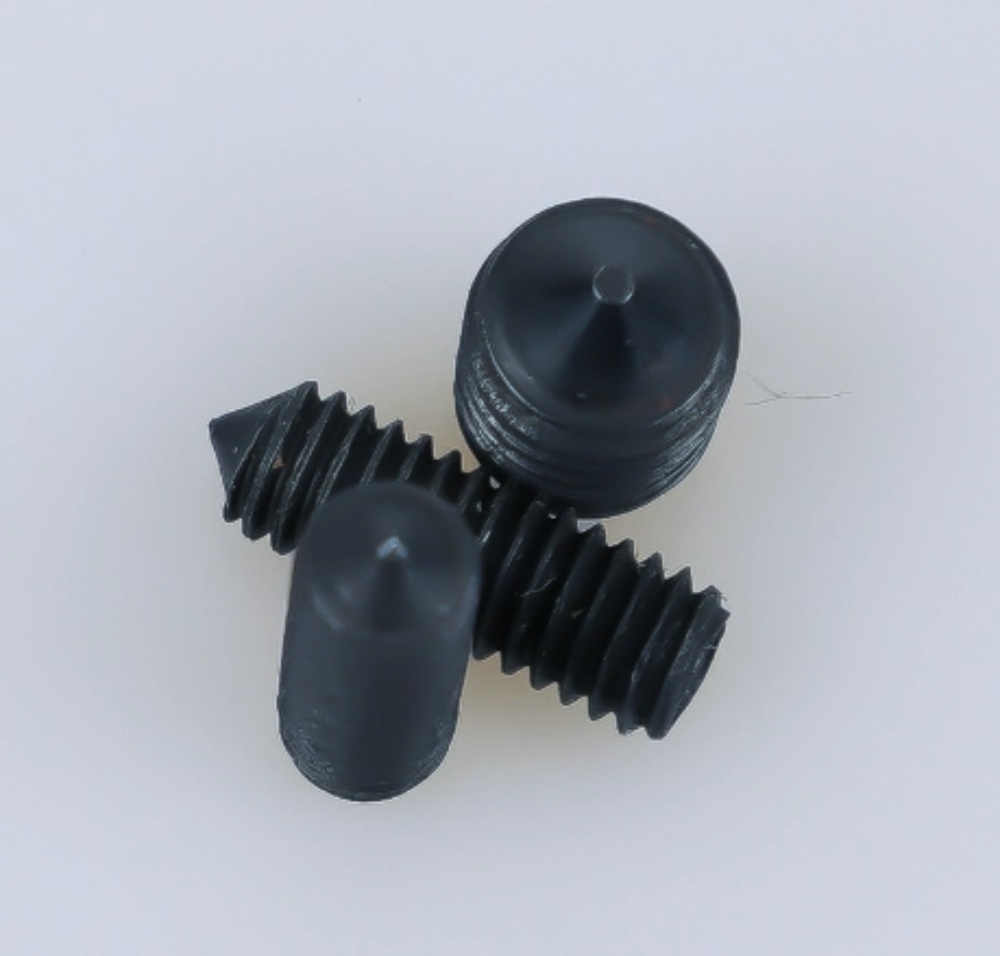
Hexagon Socket Setscrews Cone Point 45H DIN 914 is suitable when the screw point needs to bite into the mating surface for stronger location. It can be used for shaft positioning, mechanical adjustment, collars, and assemblies where movement should be minimized.
DIN 914 is less suitable when the mating surface must remain clean or unmarked, because the cone point is designed to create a stronger bite. In that case, a flat point design may be easier to justify.
DIN 916 Plain Cup Point for Strong Clamping
Hexagon Socket Setscrews Plain Cup Point DIN 916 fits applications that need secure local clamping. The cup point creates concentrated contact and can help improve grip on the mating component.
This option is useful for knobs, handles, collars, and machine assembly. DIN 916 should be used with care on soft or finished surfaces, since the cup point may leave a visible mark under tightening force.
DIN 913 Flat Point for Surface Protection
Hexagon Socket Setscrews Flat Point 45H DIN 913 is better when fastening stability is needed but surface damage should be reduced. The flat point spreads contact more gently than cone or cup points.
DIN 913 is not the most aggressive option for biting into a shaft, but it is useful when surface protection, removability, or later adjustment matters. It can suit handles, furniture, adjustable parts, and machine assemblies where the contacted surface should stay cleaner.
What Should Buyers Check When Choosing a Setscrews Factory?
A setscrews factory can support better purchasing decisions by helping buyers look beyond the product name. For industrial orders, heat treatment quality control for set screws should be part of the supplier discussion.
Hardness and Batch Consistency
Ask how hardness is checked and whether testing can be arranged before shipment. Hardness consistency matters because one batch may be used across many assemblies. If hardness varies too much, some screws may wear quickly while others perform normally.
Qewit’s Technical Support service can help buyers discuss inspection support, batch checking, and document needs for project-based purchasing.
Material and Finish Matching
Carbon steel, stainless steel, A2-50, A2-70, and A4-70 should be selected according to load, working environment, corrosion exposure, and appearance requirements. Black Oxide, Self Colour, and Plain finishes should also be checked against the final assembly condition.
Do not choose a finish only by appearance. A black finish may suit a visible assembly, while stainless steel may be preferred where corrosion resistance is more important.
Pre Order Checklist for Industrial Buyers
Before ordering, buyers should confirm five details: point type, mating surface material, required finish, expected tightening frequency, and whether the assembly will face vibration or later adjustment. If the screw will bite into a shaft or collar, DIN 914 may be suitable. If stronger local clamping is needed, DIN 916 may be a better fit. If the contacted surface should be protected, DIN 913 is usually easier to justify. For repeat production, the buyer should also ask the setscrews factory whether hardness checking, sample review, or batch inspection documents can be arranged.
For a quick selection rule, choose DIN 914 Cone Point 45H when firm location and strong bite are more important than surface appearance. Choose DIN 916 Plain Cup Point when the assembly needs stronger local clamping. Choose DIN 913 Flat Point 45H when the contacted surface should be protected or the part may need later adjustment. If the application involves repeated tightening, machinery vibration, or batch production, ask the setscrews factory to confirm heat treatment quality, hardness checking, and material consistency before placing a larger order.
How Can Qewit Support Product Selection and Purchasing Details?
If your order involves mixed point styles, repeated assembly, or strict surface requirements, prepare the standard, size, material, finish, packaging, and application notes before sending the inquiry. For drawing-based parts or non-standard fastening needs, Qewit can review the details and help compare suitable socket setscrews. Use the official contact page to share your purchasing requirements, drawings, or inspection document needs.
FAQ
Q: What Is the Main Benefit of Heat Treated Set Screws?
A: The main benefit is better resistance to wear, point deformation, and socket damage during tightening. Heat treated set screws are useful where the screw must hold position under repeated adjustment, vibration, or higher contact pressure.
Q: Which Point Type Should I Choose for Machinery Applications?
A: Choose DIN 914 Cone Point 45H when firm location is needed, DIN 916 Plain Cup Point when stronger local clamping is required, and DIN 913 Flat Point 45H when you want to reduce surface marking. The right choice depends on the mating surface and whether later adjustment is needed.
Q: Why Should I Ask a Setscrews Factory About Heat Treatment Quality?
A: A setscrews factory that supports hardness checks, inspection, and product matching can help reduce purchasing risk. Heat treatment affects hardness, durability, and batch stability, so it should be confirmed before repeat industrial orders or assemblies where set screw failure would interrupt production.


