

caTEGORIES
Tags
Split Lock Washers vs. Star Lock Washers: Advantages, Disadvantages & Key Differences
Posted: March 12, 2026
Categories: News
Assembling a sturdy machine or a basic outdoor setup often involves facing an unseen challenge: vibration. This ongoing motion gradually causes nuts and bolts to loosen, creating risks for the entire structure. Qewit has participated in this industry since 2004, connecting British quality guidelines with cost-effective Far Eastern production methods. Situated in Qingdao, the company manages a wide range from typical DIN components to tailored supply chain services that reduce concerns.
Selecting the proper locking device requires more than choosing an item from inventory; it demands insight into how mechanical forces influence your particular application. In cases involving robust industrial machinery or sensitive cosmetic devices, opting for either a split lock washer or a star lock washer can substantially affect the longevity of your fastened joint.
How Do These Fasteners Prevent Vibration-Induced Loosening?
The principle is straightforward: without a retaining mechanism, initial friction between threads diminishes under repeated stress. Many individuals believe that a securely fastened bolt provides adequate hold, yet materials naturally expand, contract, and adjust positions over time. Consequently, these modest washers serve as essential components that prevent the assembly from disassembling unexpectedly.
Mechanical Friction and Spring Tension
Split lock washers operate similarly to compressed springs in their design. They possess a modest spiral shape, and as the nut is secured, the washer applies continuous resistance in the opposite direction. This persistent force maintains close contact between the bolt and nut threads, thereby producing the necessary friction to halt any self-induced turning of the nut. As a result, it functions as a traditional choice for standard tasks that benefit from additional fastening reliability without introducing unnecessary complexity to the process.
Structural Biting of Toothed Surfaces
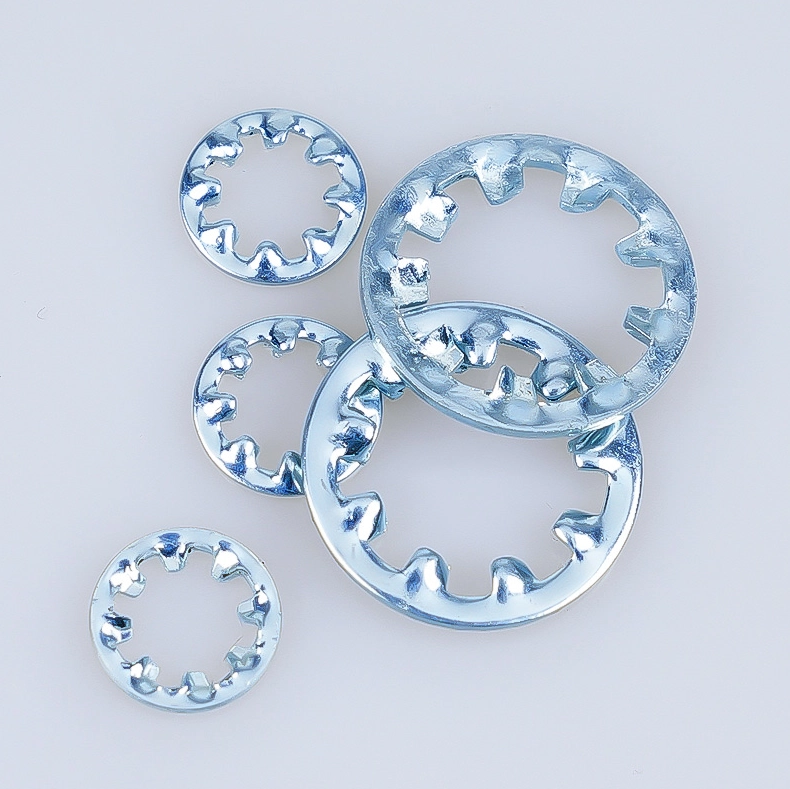
Star and serrated washers employ a more direct method of resistance. Rather than solely relying on rebound pressure, they penetrate the adjacent materials. Consider, for example, the Internal Toothed Lock Washers DIN 6797J; these include pointed extensions along the inner edge that embed into both the fastener surface and the base material underneath. Such penetration establishes a firm mechanical interlock. Therefore, should the nut attempt to rotate, it encounters substantial opposition from the embedded metal points that have integrated with the surface.
Pressure Distribution Across Contact Areas
In addition to providing locking action, these washers assist in evenly allocating the applied force. During bolt tightening, the pressure focuses intensely on a limited zone. A device like the Internal Serrated Lock Washer DIN 6798J broadens this engagement area. Through this even spread of load, it shields the joined elements from compression damage or shape alteration, and simultaneously, it bolsters the firmness of the overall connection.
What Are the Key Differences Between Star and Split Washers?
Although both varieties effectively counteract bolt loosening, the selection depends on the degree of surface alteration one accepts and the intensity of vibration the connection will experience. Furthermore, various fastening requirements differ significantly in their demands.
Surface Interference and Tooth Design
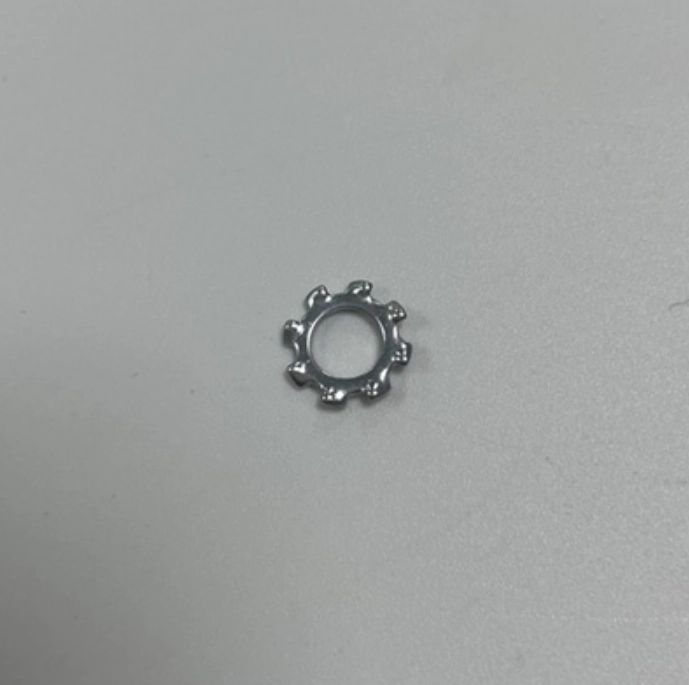
The most noticeable variation involves the presence of teeth. A split washer offers a relatively even, though divided, exterior. By comparison, a star washer, such as the External Toothed Lock Washer DIN 6797A, displays multiple raised elements across its face. Whereas the split washer depends on elastic recovery for hold, the star washer achieves security via direct surface engagement. Hence, for projects demanding a pristine, refined appearance following disassembly, the star washer may produce undesired surface impressions.
Ideal Applications for Specific Geometries
The configuration guides the suitable contexts for use. Internal toothed washers (DIN 6797J) perform well with compact screw heads or scenarios where the securing feature should remain out of sight beneath the head for an unobtrusive result. In contrast, External toothed washers (DIN 6797A) locate the teeth around the outer perimeter. This positioning affords increased mechanical advantage against rotational forces, positioning them as superior options for environments with substantial vibration in industrial settings.
Impact on the Material Substrate
One must evaluate the protective layers on the components involved. Should they include a Zinc Plated or Geomet treatment to ward off oxidation, a star washer will abrade through this barrier to establish its grasp. Occasionally, this results in minor areas susceptible to rust if precautions are overlooked. Split washers interact more mildly with such protections, even if they occasionally exhibit reduced endurance in severe impact conditions relative to a serrated DIN 6798J.
Why Choose Qewit for Your Locking Component Needs?
Procuring vast numbers of components leaves no room for uncertainty regarding material durability or the efficacy of engaging features like teeth. In such situations, Qewit’s British-directed management introduces considerable reliability within the procurement network. Far from simply dispatching packages, they oversee precise specifications, thereby alleviating concerns over potential breakdowns during operation.
Rigorous Quality Control and Certification
At Qewit, quality assurance extends beyond terminology; it gains support from specialized facilities. The team utilizes Vickers Hardness Testers and Salt Spray Test setups to confirm that all shipments of DIN 6797 or DIN 6798 washers adhere to required criteria. For initiatives necessitating records for compliance checks, they furnish options from elementary 3.1 certifications to detailed PPAP Level 3 evaluations.
Extensive Material and Finish Diversity
Regardless of the operational conditions, appropriate substances are available to suit them. Qewit maintains inventory of Stainless Steel suitable for nautical or sanitary applications, Brass valued for its conductivity in electrical systems, and robust Alloy Steel designed for intensive mechanical demands. Additionally, they accommodate numerous coating varieties, such as Hot-Dip Galvanized for external building projects or Zinc Flake (Geomet/Magni) providing advanced resistance to deterioration in vehicle contexts without introducing hydrogen fragility risks.
Bespoke Manufacturing for Unique Projects
At times, conventional DIN elements prove insufficient for the task. The aperture might require an unconventional dimension, or the substance could demand greater depth. Qewit addresses non-standard fastening products and bespoke parts derived from client-provided prototypes or schematics. Leveraging their Western-influenced methodology, they accurately fulfill technical stipulations from the outset, thereby minimizing the inconvenience of iterative adjustments with production facilities.
FAQ
Q1: Can I reuse a star lock washer once it has been tightened?
A: Typically, such reuse is discouraged. The engaging points on star washers, including those conforming to DIN 6797 or DIN 6798, deform and forfeit their penetrating capability following initial application. To preserve the security of the joint, installing a replacement unit is the recommended practice.
Q2: Which washer is better for electrical grounding?
A: Star washers generally excel in this function. Their pointed elements breach surface layers like paint and oxidation to access the core material, thus forming a more effective conductive pathway compared to flat or split washer designs.
Q3: What’s the difference between DIN 6797 and DIN 6798?
A: The distinction primarily relates to the configuration of the teeth. DIN 6797 (Toothed) features a smaller number of broader extensions, whereas DIN 6798 (Serrated) incorporates a greater quantity of finer, intermeshing points. Consequently, the serrated type tends to provide superior retention in locations exposed to elevated vibrational forces.


