

DIN 982 vs DIN 985 Nylon Lock Nuts: How to Choose for Load, Space and Vibration
Опубликовано: October 21, 2026
Категории: Новости
Теги: новости
The clearance drawing usually gives the first clue. DIN 985 is shorter, while DIN 982 leaves more room for thread engagement. Check the bolt end against nearby covers as well as the nut body, then confirm the strength pairing; the DIN number alone does not approve the joint.
The short answer: height changes the selection
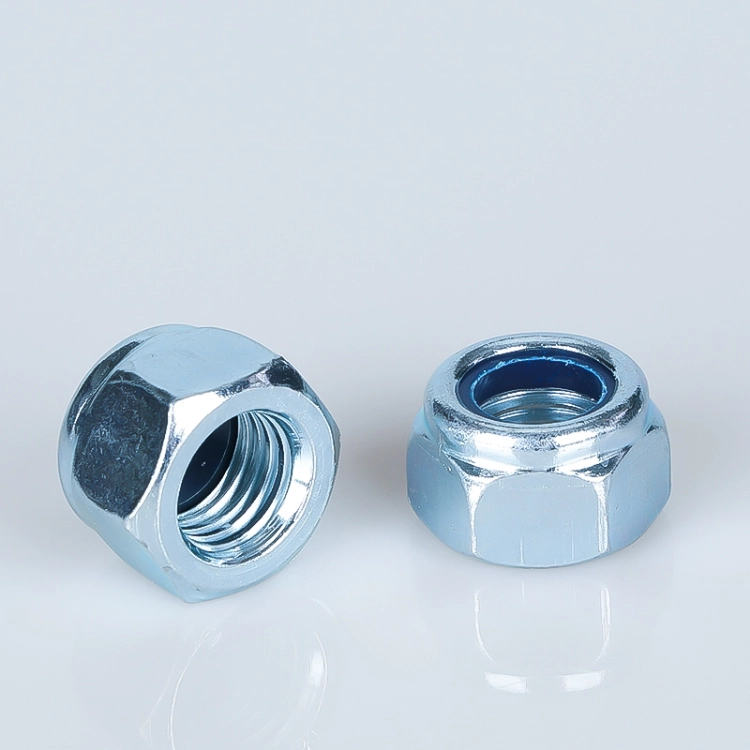
В DIN 985 nylon insert lock nut is the low-profile version, with a height of roughly 0.8 times the nominal diameter in the product guidance. The DIN 982 version is closer to one diameter high. Those ratios help explain the difference, but use the drawing for the size you intend to buy: a catalogue photo cannot establish clearance.
| Decision point | ДИН 985 | ДИН 982 |
| Body height | About 0.8D; lower profile | About 1D; taller profile |
| Thread engagement | Shorter | Longer |
| Typical fit | Restricted space; light to moderate load | Moderate to heavy load; vibration-prone joint |
| Main limitation | Less engagement when the joint needs a taller nut | Needs more installation clearance |
How the nylon insert resists loosening
The bolt thread has to push its way through the smaller nylon collar. The collar then bears against the thread, adding turning resistance even before the nut reaches the joint face; that initial resistance is known as prevailing torque.
A torque wrench feels resistance from the nylon before the nut seats. That resistance contributes to the reading, but it does not create clamp force in the joint. The tightening instruction should match the bolt, nut, finish and lubricant in use. Кьюит explains the friction side of this in its guide to bolt-and-nut torque settings.
Choose DIN 985 when clearance is the binding constraint
A cover that closes over the end of a bolt is one reason to specify DIN 985. So is a bracket with limited socket access. Check the nut and the protruding bolt together; reducing nut height achieves little if the bolt end still hits the cover.
Watch the final thread position. The bolt must reach the nylon collar, not merely enter the metal body. A short bolt can leave an apparently complete assembly with no insert engagement. Burrs and damaged starting threads create another problem: they can cut the collar during the first installation.
Choose DIN 982 when engagement and vibration margin matter
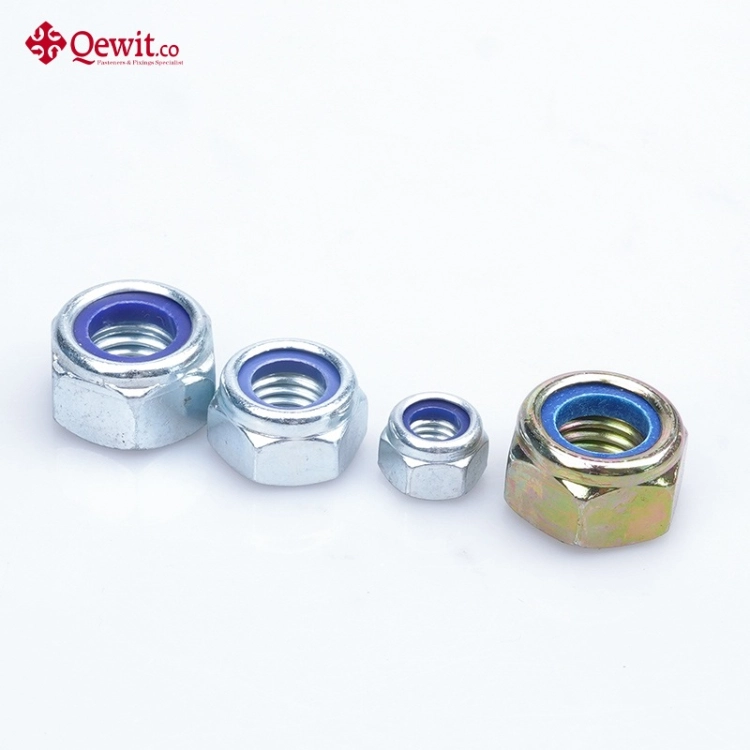
DIN 982 offers a greater amount of metal thread for thicker stacks or for joints subject to vibration. However, this must be seen in terms of the geometric advantage and not in terms of increased proof load. The actual nut’s proof load depends upon material and strength class.
There is a trade-off with height in very tight assemblies. A DIN 982 nut may even require a longer bolt and get in the way of a cover or other moving part. Check socket access and the full installed part envelope before deciding to swap DIN 985 nuts for these. A nut that cannot be reached squarely by the appropriate tool is of no use whatsoever.
Temperature and reuse limits need project confirmation
Just because a nut fits mechanically does not mean it is suitable for the service for which it is being used. In addition to mechanical fit, time, temperature and chemical exposure all affect the insert. One short warm up does not constitute continuous exposure to heat. Find out the limit for the actual insert grade and the exposure conditions to which it will be subjected.
If the assembly will be opened for maintenance, decide in advance whether the nut is replaced or inspected for another use. Look for a cut or loose collar, and follow the governing procedure if it calls for a prevailing-torque measurement. Frequent removal may make an all-metal design worth comparing on lifecycle cost.
A practical purchasing checklist
- Check for DIN 982 or DIN 985 on the drawing instead of just ordering a ‘nylon lock nut’!
- Match thread size, pitch, material and finish to the mating bolt and its environment.
- Verify nut height, socket clearance and required bolt protrusion after stack assembly.
- Request relevant dimensional and performance documentation for the ordered lot.
- Verify prevailing torque and clamp requirements at specified temperature and vibration conditions.
Reading the installed dimensions
Start with a section drawing of the complete assembly and mark on the bearing face and the full thickness of any parts being clamped. Show the end of the bolt. Include any designer-specified washers. It is much easier to assess the nylon collar’s engagement and the required clearance above it with a complete section drawing as opposed to a drawing of just the nut. A change in the thickness of a washer can have a huge impact on both checks even though the bolt and nut dimensions remain unchanged. Protrusion should be shown on the approved drawing and not assumed to be OK if the bolt end appears to be flush with the surrounding material.
Tool clearance also deserves a separate check. Even though a nut looks like a hexagon outside, a socket has to have clearance between the flats, and access to sit flat on the nut. By the time a nut has been installed, it may clear the cover, but be impossible to tighten up inside the enclosure. Check the installation sequence as well as the finished dimensions to see if the nut can be tightened up before the adjacent part is installed. Will maintenance have the same access to tighten the nut up? These are more important questions than just comparing the weights of similar products from catalogs.
Matching the nut to the bolt specification
A purchasing description should link the DIN number of a lock nut to the mating bolt. The nominal diameter, the pitch and the material of the nut have to match. In addition, the required strength of the nut must match the joint for which the nut is intended. Just because a lock nut is taller than another does not necessarily mean that an unspecified nut can be paired with a stronger bolt and still be safe. Therefore, in addition to the dimensional documents, also request the performance documents of the item that is being quoted. Compare these with the relevant drawing. If the supplier offers an alternative number, clarify the dimensions and performance of this alternative before ordering, even though it may have the same name as the number that was specified originally.
Similarly, when considering changes to finish, such as swapping to an apparently similar alternate finish, ensure that the altered item is reviewed with similar attention. Ensure that the agreed finish is noted on the purchase order and on the relevant part of the instruction for tightening the part. While a production trial may have used an alternate finish temporarily, do not ‘inherit’ approval of that alternate finish for later use. A buyer may purchase a nut from one supplier and a bolt from a second; each part may satisfy the relevant requirements for that part but not provide for a suitable installation procedure when used together as a complete assembly.
Comparing compact and heavier assemblies
One example could be a compact electrical cabinet bracket with a cover which is positioned close to the end of the bolt. Here first the space required axially by DIN 985 has to be checked. Subsequently it has to be clarified whether the bolt really reaches into the insert and whether the required engagement and strength are met. For a pump support or a heavier frame with more space available than with a cabinet, it might be worth to also check DIN 982. These examples are not meant to suggest that every cabinet needs DIN 985 and every pump DIN 982. The decisive factors are the load, the vibration and the joint drawing.
The joints must be supported and fixed in the correct way when they vibrate. The nylon insert is designed to resist nut rotation but it cannot recover from any loss of clamp force due to settling or misassembly. So a trial of assembled joints is more relevant than just the torque required to turn the nut by hand. Set out the service conditions and acceptance criteria for the trial and don’t assume that increasing the height of the nut will be adequate if the nylon insert is exposed beyond its design limits. The locking mechanism itself needs to be revisited.
Planning inspection and maintenance
Inspection on receipt of products needs to allow easy identification of the variant ordered. Labels, nut height, thread diameter and finish should be inspected against the approved specification with recording of lots opened as required by the specific project. Do not rely on color to identify between different materials or insert variants. Visible thread damage or displaced collars must be rejected against the applicable inspection procedure and any assembly problems recorded so that they can be investigated against the specific bolt and nut actually used as opposed to being wrongly accused of any problem of the DIN number variants.
Design the work instruction for the maintenance action under which the joint is opened and include the reuse decision there. The product supplied contains a supply of product guidance which outlines a number of assembly cycles. However this does not guarantee that every nut will be suitable for every exposure. Factors such as a damaged collar, unsuitable heat history or failing the prevailing-torque check can indicate unsuitability for reuse earlier than the above outlined limit for assembly cycles. Where the cost of inspection is greater than the cost of replacement then a replacement policy may be suitable. Where frequent removal is necessary then compare other locking methods with the designer and do not rely on a taller nylon nut to solve the insert wear problem.
Frequently Asked Questions
Are DIN 982 and DIN 985 interchangeable?
As with any component, the fit and performance must first be verified. The locking principle is similar to other height variations, but DIN 982 is taller which affects clearance and engagement. Just having the same thread size does not make it an interchangeable part.
How many times can a nylon lock nut be reused?
There is no safe number of reuse that applies universally. The number of reuse depends on the assembly method, the collar, the prevailing torque and the usage of the assembly. If reuse is allowed then removals must be recorded in accordance with the procedure.
Can a nylon lock nut be used at high temperature?
Check the specific insert rating. Although a nut of this type will survive short periods of high temperature, an insert near room temperature can be unsuitable for use in a continuously hot enclosure.


