

Категории
T Bolts for Machine Slots: DIN 186, DIN 787 and Hammer Head Choices

Опубликовано: November 26, 2026
Категории: Новости
The name “T bolt” causes more confusion than it should. A buyer sends that description, the supplier sees a long rectangular head, and everyone assumes the same part is in mind. Then the sample reaches the machine and will not enter the slot, turns during tightening, or sits on two corners instead of its full face. I have learned to start with the slot drawing, not the bolt name.
The slot decides which head belongs there
The wide head disappears behind a rail, channel or machine-table slot. Inside, it has two jobs: sit on the right faces and stay put while the nut turns. That sounds simple. In practice, a few millimetres at the head can decide whether the bolt works at all.
I record the slot opening, internal width, internal depth and entry method. Can the head drop through an open end, or must it pass through the opening and turn? Is there a radius inside the channel? Does the rail have a lip? A clean sketch with those four points tells a supplier more than a photograph taken from above.
Qewit lists a stainless steel hammer head bolt for special assemblies. It is a useful reference, but its page does not replace the buyer’s rail dimensions. The matching check still has to be made against the actual channel.
Why I do not swap DIN 186 and DIN 787 by name
Search results put DIN 186 and DIN 787 under T bolts. At the bench, I still compare the heads instead of swapping one name for the other. The practical question is where the head carries load inside the slot. A head made for one table or channel profile may rock in another.
Start with a section view
For a new enquiry, I ask for a section through the slot. The view should show the narrow opening, the wider cavity below it, both corner radii and the available depth. Next I add the head width, head length and head thickness of the proposed bolt. If these dimensions are missing from the offer, approval waits.
There is another small check that saves trouble: show the installation route. Some heads enter from the end of a channel. Others are introduced through an opening and rotated. A head that fits once it is inside may still be impossible to install on a closed frame.
Hammer head is a family description
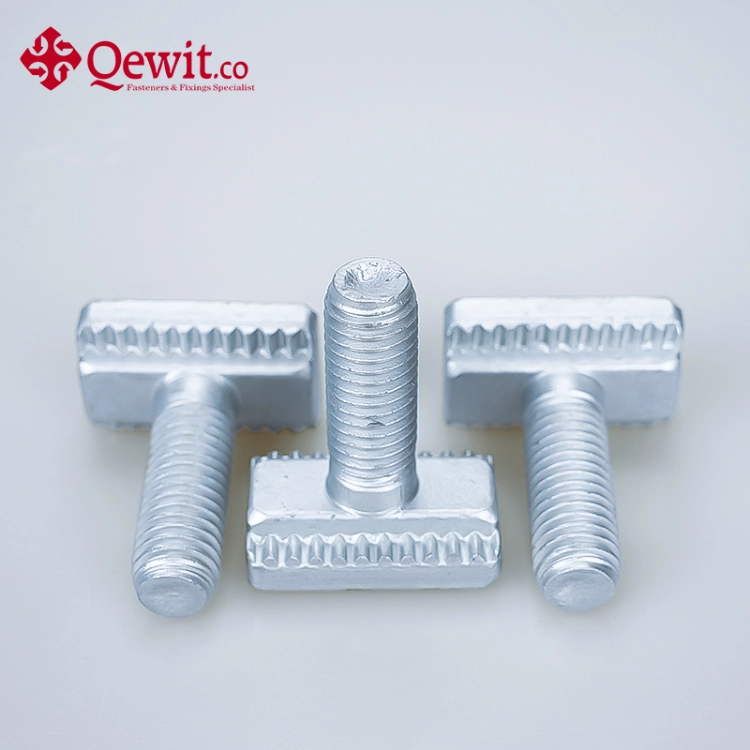
“Hammer head” describes the general appearance, not a complete interchangeability rule. The underside may be flat or shaped for a particular channel. Corners may be square or radiused. Neck geometry can also control rotation. For replacement work, I keep an old approved part, measure it and label it with the machine or rail number. That is safer than ordering from a small catalogue picture.
Qewit’ с special parts range is the right place to discuss a head that does not match a standard drawing. A supplier needs the slot section and the working length above the head before suggesting a special version.
Coarse or fine thread depends on more than vibration
The October questions include coarse versus fine thread for vibrating equipment. Fine pitch is sometimes chosen where adjustment is important or where the same nominal diameter needs a smaller thread movement per turn. Coarse pitch is common, easier to identify in the field and generally less sensitive to dirt or small handling damage.
I do not write “fine thread for vibration” as a blanket instruction. On a vibrating machine I look at the whole joint—clamp load, nut, contact face, rail movement and locking method. A fine pitch does not correct a loose head inside the slot. Nor does it fix a nut that bottoms before the parts are clamped.
For service parts, pitch must be measured, not guessed. I use a pitch gauge and check it against the mating nut. My RFQ says M12 × 1.75, for example, never just M12. The nut and any locking element must match that pitch.
Anti-rotation must work before full tightening
The head or neck is expected to stop the bolt turning while the nut is run down. There are two common ideas in buyer enquiries: a square neck that keys into a matching opening, or serrations that bite into a surface. They do different work.
A square neck needs a receiving shape with enough engagement. If the opening is round or oversized, the corners do little. Serrations need a surface they are allowed to mark. On coated rails, stainless channels or parts opened during maintenance, those marks may not be acceptable.
I make a hand-tight test first. With an ordinary spanner on the nut, the bolt should remain where I placed it. A head that slides, tips or spins before clamping is telling me the fit is wrong. Pliers on the threaded end are a warning sign, not an anti-rotation method. They chew the thread and disguise the bad fit.
Choose the finish for the real environment
Zinc plated, hot-dip galvanized and black finishes are often offered on carbon steel T bolts. These are three different purchasing choices, not colour samples.
For indoor or mildly exposed hardware, thin zinc plate is a common starting point. HDG puts on a heavier layer for tougher outdoor exposure. That extra build-up can tighten the thread and close up a narrow slot. Black-finished parts may be fine inside a controlled machine room. I would not call that outdoor protection unless a coating system says so. Stainless material is another option where the environment and mating materials justify it.
When I review a coated sample, I try it in the actual slot. A head that fitted before coating may become tight at the channel lip. I also run the correct nut over the thread and watch for coating being scraped away. For HDG, buyer and supplier need one answer on nut-thread preparation and paired supply.
Finish selection also includes the rail. Put stainless beside another wet metal and galvanic corrosion enters the discussion. A serrated head can cut paint and leave carbon steel bare in a small moisture trap. I mark on the drawing where tooth marks are allowed and where the finish must stay whole.
Put fit checks into the RFQ
A useful T-bolt enquiry is short, but it is not vague. Mine includes:
- Standard or controlled drawing number
- Thread diameter, pitch and usable thread length
- Head length, width, thickness and neck form
- Slot opening, cavity width, depth and corner radius
- Installation route through the end or through the opening
- Material, finish and service environment
- Mating nut and any locking method
- Required inspection or material documents
For an unusual rail, the non-standard product service gives the buyer a route to send a drawing rather than forcing a near-standard bolt into the job. I mark critical dimensions on the drawing and ask for them on the sample report. A part does not pass simply because it looks right.
During sample fitting, I check that the head enters, turns if required, lies flat and cannot pull through the slot. Then I run the nut through the full working range. Finally, I remove the sample and inspect the rail for gouging, cracked coating or a two-corner contact mark. I attach those notes and photographs to the approval.
Вопросы, которые задают покупатели перед оформлением заказа.
Can DIN 186 replace DIN 787 if the thread size is the same?
Not on thread size alone. Compare the complete head and neck geometry with the slot section, including the entry route and internal radii. The bolt also needs the correct working length and pitch. Any change goes back through the fit trial.
Is fine thread always better on vibrating machinery?
No. Fine pitch may suit adjustment or a particular joint design, but vibration resistance depends on clamp load, locking method, mating parts and movement in the channel. Confirm the pitch used on the machine and approve the joint as a system.
Which finish should I put on the T-bolt RFQ?
State the environment, rail material and permitted surface damage. Zinc plated, HDG, black finish and stainless material have different coating thickness, corrosion behaviour and fit effects. With little slot clearance, ask to try the coated part itself.
Approve the bolt in its own channel
Отправлять Кьюит the bolt drawing and a section of the rail. If a used approved sample exists, identify it and include its measurements. The final decision should come from a fitted sample in the correct channel, with the mating nut and finish that production will use.


