

CATEGORÍAS
Etiquetas
How to Choose Self Drilling Screws for Thick Steel
Publicado: October 08, 2026
Categorías: Noticias
Etiquetas: noticias
Choose self-drilling screws for thick steel by matching the exact screw’s documented drilling capacity to the steel grade and thickness being drilled. Then check the assembly thickness, usable bearing length, required connection strength, and installation instructions. A long screw or a No. 5 drill point alone does not establish suitability.
For buyers specifying bi-metal screws, one more dimension matters: how much of the fastener’s load-bearing section is corrosion-resistant stainless steel. The drill tip may penetrate the support successfully while the selected screw is still unsuitable for the complete assembly. Treat drilling, clamping, and load capacity as separate checks.
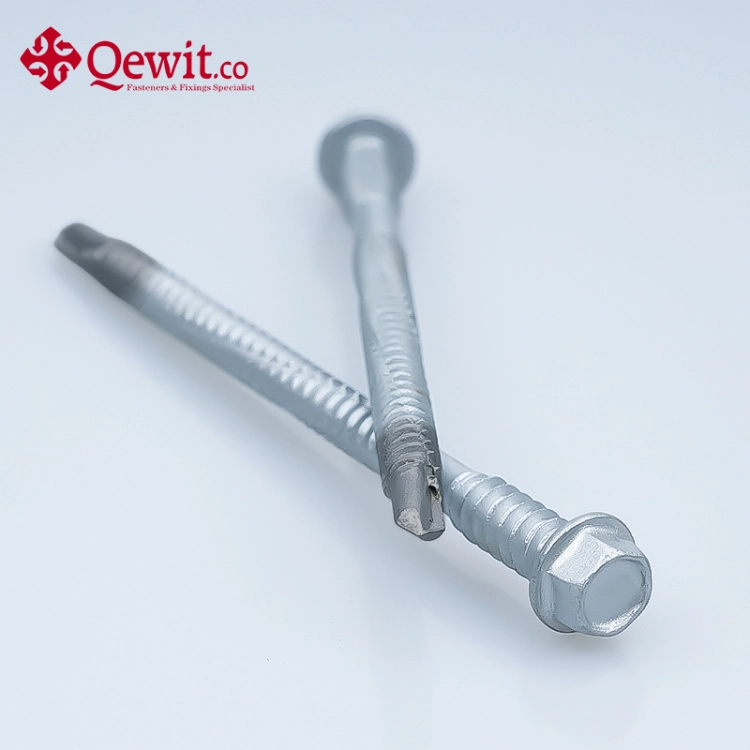
Qewit‘s product range includes bi-metal self-drilling screws with different point configurations. This guide explains how to compare those options and prepare a purchase specification without turning a catalog maximum into an unsupported application promise.
Define the steel and the complete material stack
Start with the material the tip must drill through. Record the supporting steel’s thickness, grade, and any coating. Also identify the attached sheet, bracket, or other component. Where the screw passes through multiple steel layers, describe each layer and the presence of gaps rather than supplying only one total thickness.
For example, a thin sheet fixed to a thick support is not automatically equivalent to a single solid plate with the same combined thickness. The tip, flutes, and threads encounter the materials differently. Request confirmation that the selected screw is suitable for that actual configuration and installation direction.
Separate the material being drilled from the total assembly being clamped. A spacer or nonmetallic component may increase the required fastener length without adding the same drilling demand as steel. Both measurements belong in the RFQ because they answer different selection questions.
Read drilling capacity by product and size
Drill-point numbers help organize screw families, but their published capacities must be checked against the manufacturer’s exact product. Diameter, tip geometry, steel conditions, and installation instructions all matter. Do not apply a generic internet chart to every screw with a similar-looking point.
Qewit’s catalog provides a useful example of product-specific differences:
| Catalog field | Qewit Point No. 3 listing | Qewit Point No. 5 listing |
| Listed diameters | 5.5 and 6.3 mm | 5.5 mm |
| Maximum drilling capacity | 6 mm | 12 mm |
| Maximum listed speed | 2500 RPM | 1800 RPM |
| Listed material combination | SUS304 or 316 plus 410 | SUS304 or 316 plus 410 |
These figures come from Qewit’s Point No. 3 y Point No. 5 product pages. They are catalog limits for those listings, not universal ratings for all No. 3 or No. 5 screws. Confirm the chosen size, steel strength, layer arrangement, and current installation instructions before ordering.
The listed maximum RPM is a ceiling, not a target for every application. Likewise, a 12 mm drilling limit must not be rounded up to half an inch: half an inch is 12.7 mm. That difference matters when an imperial drawing is translated into a metric purchase specification.
Understand what bi metal construction changes
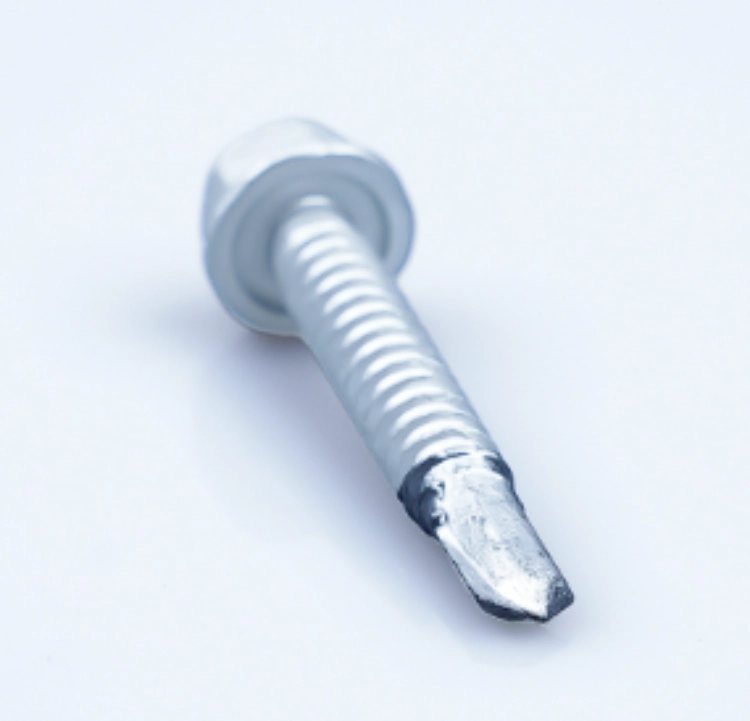
Bi-metal self-drilling screws combine sections intended to perform different functions. A corrosion-resistant body serves the fastening application, while a harder drilling section forms the hole. The precise material combination varies between manufacturers and product families.
For example, SFS describes its Bi-Met 300 range as combining a 304 stainless steel body with a hardened carbon-steel tip and lead threads. Qewit’s cited listings identify SUS304 or SUS316 combined with 410. These descriptions should not be merged into one universal material recipe.
Ask the supplier to identify the body material, drilling-tip material, and their junction on the product drawing. Also confirm the finish and any separate washer material. The term “bi-metal” does not, on its own, establish a corrosion rating, a building approval, or suitability for every outdoor environment.
Check bearing length as well as screw length
Overall screw length includes sections that may not provide the required stainless load-bearing length. Buyers therefore need the manufacturer’s definition of bearing length or grip range, including how washers and the material junction affect it.
The practical purchasing lesson is to request the equivalent dimensional information for the screw being quoted. A longer nominal screw does not answer where its material junction will sit within the assembly. Nor does visible thread projection by itself prove that the specified stainless bearing section covers the required thickness.
An illustrative selection check
Suppose a bracket is being attached to a thick steel support. First, confirm that the tip can drill the actual support and any other steel layers in its path. Next, compare the complete application thickness with the manufacturer’s permitted clamping and bearing dimensions. Finally, check the specified thread engagement and tip projection. Passing one of these checks does not remove the others.
Separate drilling performance from connection strength
Drilling capacity describes the material thickness the screw is intended to penetrate under stated conditions. It does not give the allowable tensile, shear, pullout, or pull-over load of the connection. A screw that installs successfully still needs suitable performance data for the application.
Ask for results applicable to the substrate thickness and grade, fastener size, and connected material. Identify whether published values are ultimate test results or allowable design values. SFS’s SD5 sheet, for example, expressly labels its reported values as ultimate values with no safety factor applied. Such numbers cannot simply be copied into a safe-working-load specification.
Where an engineered connection requires an approval or design calculation, request documentation for the exact proposed product and use. A competitor’s approval, a generic material certificate, or a successful sample installation cannot substitute for that requirement.
Match the head and washer to the application
A hex washer head provides a driving surface and an integral bearing flange. It does not automatically provide a weather seal. If the assembly needs sealing, specify the separate sealing-washer arrangement, its material, and compatibility with the exposure conditions.
Check tool access around the head and the bearing surface against the attached component. Thin sheet and thicker brackets can impose different requirements on that contact area. Confirm whether washers are included in the quoted configuration and whether their thickness is already accounted for in the supplier’s grip or bearing-length definition.
Confirm installation conditions before bulk purchase
Obtain the manufacturer’s instructions for tool type, rotational speed, depth or torque control, and required alignment. Instructions are product-specific: the SFS SD5 sheet does not recommend impact guns or hammer drills, but that statement should not be treated as a complete installation specification for another brand.
Use a representative sample assembly to check drilling, seating, and thread formation under the intended production conditions. Record the actual steel, screw size, tool, and settings so the result can be repeated. Samples should represent the proposed supply specification rather than an unspecified screw from a mixed box.
If a tip stalls or breaks, investigate capacity, substrate condition, alignment, and swarf clearance before increasing speed or force. Installation trials can reveal a mismatch; they do not establish long-term corrosion performance or an allowable structural load.
Send a complete specification to Qewit
For a useful product recommendation and quotation, provide Qewit with:
- A drawing of the material stack, with each thickness and steel grade.
- Exposure conditions and required body, tip, finish, and washer materials.
- Required diameter, head style, and dimensional constraints.
- Drilling, bearing-length, thread-engagement, and connection-load requirements.
- Applicable approvals, test documentation, and traceability requirements.
- Quantity, packaging, installation equipment, and sample-trial needs.
Send those details through Qewit’s contact page and request the current drawing and installation sheet for the proposed item. This gives both sides a clear basis for confirming suitability before the order moves into bulk supply.
Preguntas frecuentes
Can a No. 5 self drilling screw drill any thick steel?
No. Check the exact product’s capacity and permitted steel conditions. Qewit’s cited No. 5 listing gives a 12 mm maximum, which does not establish suitability for thicker plate, harder steel, or every layered assembly.
Does a longer screw have greater drilling capacity?
Not necessarily. Overall length helps accommodate the assembly, while drilling capacity depends on the specified drilling section and application conditions. Select length and drilling capacity separately, then verify their combination for the quoted size.
Are bi metal screws completely corrosion proof?
No universal corrosion-proof claim follows from the name. Check body and tip materials, coatings, washers, exposure, and contact with other metals. Obtain evidence for the actual product and environment rather than assuming all bi-metal constructions perform alike.


